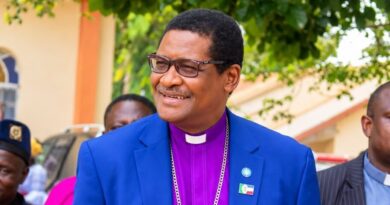

Leaders Must Show Faith Through Actions – Bishop Idowu Fearon
Former Secretary-General of the Anglican Communion Worldwide, Bishop Josiah Idowu-Fearon, has said Nigerians are facing severe economic hardship and urged the Federal Government to acknowledge the situation rather than deny it. He spoke in an interview with SAXONE AKHAINE, where he addressed Nigeria’s worsening poverty, the Tinubu administration’s economic policies and the growing influence of religion in politics.
The former Anglican leader said his recent interactions with communities in Kaduna had given him firsthand knowledge of the hardship confronting ordinary Nigerians. Since retiring to Kaduna, Idowu-Fearon said he had received permission from the Archbishop of Kaduna, Most Rev. Timothy Yahaya, to continue ministerial activities in the diocese.
His visits to communities, according to the cleric, have exposed the depth of the economic crisis.
“There is no doubt about that,” he said when asked whether Nigerians were suffering.
Idowu-Fearon said the impact of poverty could even be seen in church attendance. Some worshippers, he explained, struggle to afford commercial transport to religious services. In some cases, churches now provide buses to transport members who cannot afford the cost of getting to worship centres.
The former Anglican secretary-general recalled visiting a church where about 80 buses transported more than 2,000 worshippers.
ALSO READ: My Sacrifice to God Broke Poverty’s Backbone-Pastor Ibiyeomie
Such arrangements, he said, demonstrate the financial difficulties facing many families.
Idowu-Fearon also spoke about the effect of poverty on household nutrition. According to him, some families can only afford one meal a day and struggle to provide balanced meals for their children. He said rising prices had further worsened the situation, noting that money that once bought several household items now purchases very little.
“When you take N1,000 to the market, what do you come back with? Almost nothing,” he said.
The cleric also questioned claims about increased government revenue and allocations to states and local governments.
“If trillions of naira are coming in and going to the state governors and local government chairmen, where is the money?” he asked.
Rather than deny the hardship, Idowu-Fearon urged the government to acknowledge the reality and explain the measures being taken to address it. He acknowledged that political parties could exploit economic hardship for electoral advantage. However, the former Anglican leader said Nigerians should also demand clear explanations from politicians who make promises during election periods.
ALSO READ: Bishop Oyedepo Says Fellowship With God Brings Strength
Religious Leaders and Politics
Idowu-Fearon also criticised the growing relationship between religious leaders and politicians. According to him, religious leaders risk losing their moral authority when they become too close to political actors. He said the responsibility of clerics includes speaking truth to power and representing the concerns of ordinary citizens.
When religious leaders become financially dependent on politicians, Idowu-Fearon argued, their ability to challenge government decisions can become compromised. The former Anglican leader said the problem cuts across both Christianity and Islam. He also rejected the argument that Nigeria’s political leadership should be determined by religious numbers.
Idowu-Fearon said the debate over whether Christians or Muslims constitute the larger population misses the central issue.
“What benefit does it bring?” he asked.
For him, the country needs leaders whose faith influences their character and conduct, regardless of whether they are Christians or Muslims. He recalled having access to former President Muhammadu Buhari and former Vice-President Namadi Sambo despite religious differences.
ALSO READ: Pastor Okonkwo Unveils Christian Matchmaking Platform, VIP Plan
According to Idowu-Fearon, both men supported initiatives at the Kaduna Centre without making religious affiliation a condition for assistance. He therefore argued that Nigerians should focus less on whether political leaders share their faith and more on their ability to govern fairly.
The former Anglican leader also recalled Buhari’s position that Nigeria does not need a Muslim or Christian President but a President who happens to be either Christian or Muslim.
Kaduna Peace Commission
Idowu-Fearon also discussed the end of the Kaduna State Peace Commission, where he previously served as chairman. He explained that the law establishing the commission provided for a five-year tenure. By the time the commission ended, its members had already served beyond the statutory period.
Idowu-Fearon said the former administration had initially established the commission to address conflict and promote peace in the state.
However, discussions with officials of the current administration suggested a shift towards conflict prevention. He said the government had not yet fully engaged the commission’s former members in the new process.
ALSO READ: Bishop Oyedepo Says Fellowship With God Brings Strength
Still, Idowu-Fearon expressed willingness to continue discussions with the Secretary to the State Government on peacebuilding efforts.
Kaduna’s Religious and Political Balance
On Governor Uba Sani’s decision to return to a Muslim-governor and Christian-deputy arrangement in Kaduna, Idowu-Fearon said the state’s unique circumstances should guide political decisions.
The former peace commission chairman has extensive academic experience on Kaduna’s religious composition.
His PhD research at Ahmadu Bello University focused on “Religion, Social Responsibility and Development in Kaduna State.” He said his research examined communities with Muslim majorities, Christian majorities and areas where both faith groups had relatively equal populations Idowu-Fearon described Kaduna as a complex state whose religious composition requires careful political consideration.
Although he maintained that he does not support either Muslim-Muslim or Christian-Christian political arrangements as a general principle, he said Kaduna’s circumstances could justify the current arrangement. He stressed, however, that electoral victory ultimately depends on voters across religious communities.
“If all Muslims in Kaduna refused to vote for Uba Sani because of this decision, and only Christians voted for him, he could not win,” Idowu-Fearon said. His comments come amid renewed debates over poverty, religious identity and political representation as Nigeria moves closer to the 2027 general elections.
Source: Guardian News
Content Credit: Esther Adeyemi
Image Credit: Facebook.com