
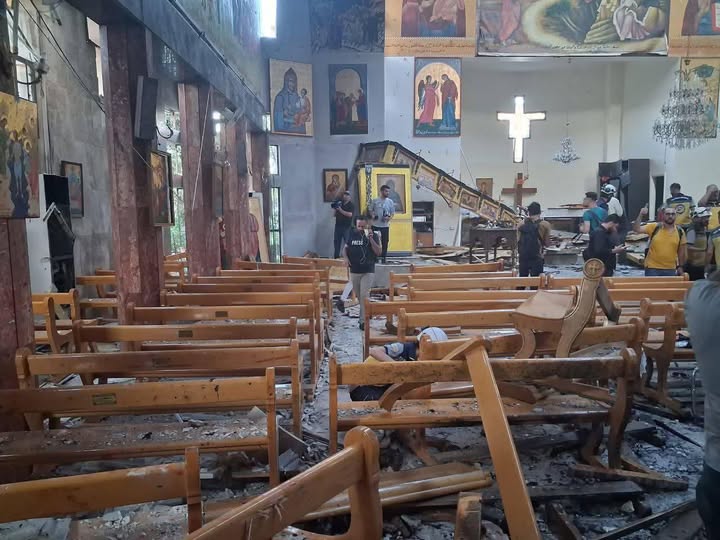
Terror in Damascus: Jihadist Kills 22 Christians During Worship
Inside the Damascus Church Massacre: What Happened, Why It Matters, and Why the World Looked Away
Damascus, Syria; What was meant to be an evening of worship turned into one of the deadliest attacks on Christians in recent Syrian history. On 22 June 2025, a violent assault on Mar Elias Church in the Dweil’a district left at least 22 worshippers dead and more than 60 others wounded, according to early reports from local authorities and international observers.
Witnesses say the attack unfolded during the evening Divine Liturgy, when the church was packed with families, elderly parishioners, and young people. An assailant, believed to be affiliated with the Islamic State (ISIS/ISIL), entered the church, opened fire on the congregation, and then detonated an explosive vest, turning a peaceful service into chaos. Some accounts suggest a second gunman may also have been involved.
Scenes of Devastation
Survivors described a horrific aftermath: shattered pews, bodies lying across the floor, smoke, blood, and panicked cries for help. Civil-defense teams who arrived at the scene later recovered additional remains beneath the rubble.
Casualty figures varied as the situation developed, with some estimates rising to 25 victims amid the confusion of emergency response efforts.
The attack sent shockwaves through Syria’s Christian minority community, already fragile in the wake of the country’s shifting political climate following the fall of Bashar al-Assad in December 2024. Religious leaders worldwide denounced the bombing, with the Assembly of Catholic Ordinaries in the Holy Land calling it “unspeakable evil” and a direct assault on the right to worship freely.
Why the Attack Matters: A Deepening Security and Social Crisis
A Return of Sectarian Violence
The Mar Elias bombing marks the first major attack on a church in Damascus in several years. The deliberate targeting of a sanctuary, especially during a sacred ritual, has intensified fears among Syria’s religious minorities, many of whom had cautiously hoped that the post-Assad era would usher in improved security.
A Test for Post-Regime Syria
The attack highlights the volatile environment facing the new interim government. Analysts say that extremist groups may be attempting to exploit political instability, testing the strength of security forces and the nation’s commitment to protecting minority rights.
A Blow to Interfaith Coexistence
Syria has long been home to diverse religious communities living side by side. But the bombing threatens that delicate balance. Community leaders warn that repeated attacks like this could deepen distrust between Muslims and Christians, damage that may take generations to repair.
Read Also: Putin Bans All Satanic Temples Nationwide in Russia
Why the World Barely Noticed: Understanding the Under-Reporting
Despite the scale and brutality of the attack, the Mar Elias Church massacre did not dominate global headlines. Several factors help explain why.
1. News Fatigue in a Region of Constant Crisis
The Middle East is often perceived as a region of unending turmoil. With frequent bombings, conflicts, and political upheavals, even large-scale attacks can get lost in the noise. International audiences, overwhelmed by crisis after crisis, may struggle to follow every incident.
2. Post-Regime Political Priorities Overshadowing Human Stories
Following Assad’s removal, media attention has focused heavily on political transitions, negotiations, and reconstruction. A church massacre, even one this deadly, may have been pushed aside by stories deemed more geopolitically significant.
3. Conflicting Casualty Figures
As with many attacks in unstable regions, early reports presented differing death tolls. Such inconsistencies can cause media outlets to hesitate, waiting for “confirmed” numbers and sometimes abandoning the story altogether when clarity is slow.
4. Violence Against Minorities Often Receives Less Amplification
Christians in Syria represent a religious minority. Historically, attacks against minority groups in conflict zones often receive less global attention unless tied to a larger political narrative.
5. Restricted Media Access in Syria
Journalists face major obstacles in Syria—including security risks, limited access, and government control or manipulation of information. These challenges make comprehensive coverage difficult, resulting in brief, fragmented reporting that fades quickly.
The Human Cost of Being Forgotten
When tragedies like the Mar Elias bombing slip out of public consciousness, much is lost:
Victims Become Numbers, Not People
Without continued attention, families grieve in silence. The world never learns their names, their stories, or the futures they were denied.
Communal Trauma Goes Unaddressed
Failing to acknowledge such violence deepens the psychological wounds of communities already living in fear and uncertainty.
Accountability Weakens
When media attention shifts, pressure on authorities to thoroughly investigate and prevent future attacks diminishes, creating an environment where impunity can thrive.
History Risks Being Erased
Events that are not fully reported or remembered are easily forgotten—sometimes rewritten, sometimes denied.
A Call to Remember, a Call to Witness
The massacre at Mar Elias Church is more than a tragic headline—it is a stark warning about the fragility of peace in Syria’s transitional era. It is a reminder of the relentless threat posed by extremist ideology, and of the vulnerability of minority communities trying to rebuild their lives.
Above all, it is a call to report, to remember, and to refuse silence.
The world owes the victims more than a passing mention.
We owe them acknowledgement.
We owe them truth.
And we owe them a commitment to say, with one voice:
This must never happen again.
Content Credit | theguardian.com
Image Credit | facebook.com